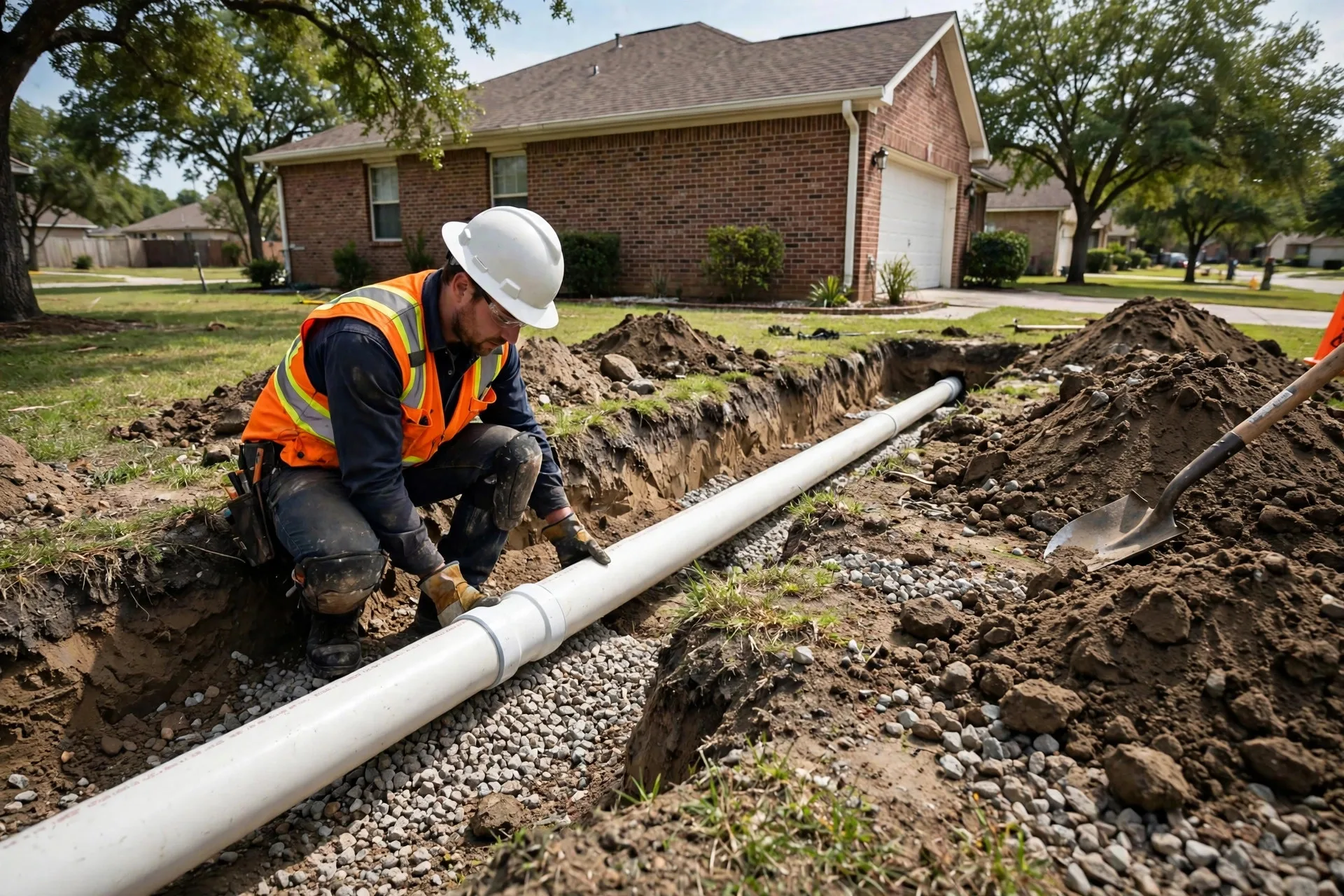
Sewer Line Replacement in Rockwall, TX
When a line is collapsed, badly bellied, or failed along its run, repair stops being honest. Replacement renews the whole run, bedded and graded for Rockwall ground.
Request Service
Tell us what is happening. We respond fast, and we show you the problem on camera before we quote the fix.
Sewer line replacement in Rockwall, TX is the work of removing a failed sewer run and installing a new line in its place, from the house to the point where the new line meets the street main. Replacement is the honest answer when the camera shows that the line has failed along its length, not at one joint, and that spot fixes would leave the next failure waiting on the same schedule. This page explains when replacement is the right call, how a line gets to that point, what the work involves step by step, and how to live through it while the yard is open.
When sewer line replacement in Rockwall, TX is the honest answer
At a glance
- Failed joints repeating along the run: replacement, not a series of repairs.
- Pipe flattened, collapsed, or deformed along a stretch: replacement.
- Bellies in sequence along the run: grade and bedding have failed along the run.
- Bore narrowed along a long stretch: no single repair restores it.
- Repairs at new points on an accelerating schedule: the line as a system has finished.
- One local failure with sound pipe around it: repair, not replacement, and the repair page covers that case.
Replacement becomes the honest answer when the failure stops being a point and becomes a pattern. A single cracked joint is a repair. Joints failing every few feet are not a series of repairs waiting to happen. They are a line that has reached the end of its service in that ground, under those trees, at that age, and repairing one joint leaves the next one to fail, and then the next, until the homeowner has paid for a repair and a replacement anyway. The camera is what shows that pattern, joint by joint, and a crew that recommends replacement without showing you that footage is asking you to trust the largest recommendation in drain work on faith alone.
A line that has lost its shape is also a replacement answer, not a repair answer. A pipe that has flattened, collapsed, or deformed along a stretch cannot be spot repaired back into a round bore. The shape is the pipe, and once the shape is gone the flow is gone with it, no matter how clean the remaining sections are. The same logic applies to bellies in sequence. One belly is a sag at one point, and a repair at that sag can restore grade. Bellies at joint after joint mean the bedding and the grade have failed along the run, and fixing one sag leaves the next sag holding water. A line with a narrowed bore along its length, where cast iron has scaled shut over a long stretch, follows the same rule: the bore is gone, and no single repair restores it.
There is also a quieter replacement case that homeowners miss, which is the line that has been repaired repeatedly and keeps failing at new points. Each individual repair was honest at the time, because each failure was local when it appeared. The pattern over time, however, tells a different story: the line is failing on a schedule, and the schedule is accelerating as the ground keeps moving and the roots keep finding new gaps. At that point replacement is not an upsell. It is the recognition that the line, as a system, has finished, even though individual sections still look repairable in isolation. The camera footage across the whole run, not one joint at a time, is what makes that call, and we show you that footage before we recommend a full run.
How a line gets to replacement: failure progression from joint gap to collapse
No sewer line goes from sound to collapsed in a single event in Rockwall ground. It travels a progression, and understanding that progression is what makes replacement feel like a diagnosis rather than a surprise. The progression starts with clay movement. Expansive clay swells when it gets wet and shrinks when it dries, and that cycle shifts the pipe at its joints. The first change is a hairline gap at a joint, small enough that the line still drains and the homeowner notices nothing. That gap is the opening for everything that follows, and it is invisible without a camera, which is why lines can be quietly failing for a long time before the first backup.
The second stage is root entry and water movement through the gap. Roots from mature oaks and elms find the gap, enter the flow, and grow into a mat that catches paper and grease. At the same time, groundwater enters through the gap and sewage leaves through it, which softens the bedding around the joint. Softened bedding lets the next clay cycle move the pipe a little more, which widens the gap, which lets in more roots and more water. That loop is the engine of Rockwall line failure: clay opens the joint, roots and water widen it, softer bedding lets clay move it further. Each cycle is small. The cumulative effect is not.
Structural change: offsets, bellies, and cracks
The third stage is structural change. A joint that has been widened by roots and water becomes an offset, where one pipe section drops below the next and creates a step that catches everything the flow carries. A section where the bedding has washed out becomes a belly, where the pipe sags and holds standing water that never fully drains. A pipe wall that has taken load it was not bedded for develops a crack, often at a joint or at a point where the bedding gave way. At this stage the line still drains, but it drains poorly, and backups become more frequent as the mat, the step, and the standing water combine to narrow the passage. Homeowners at this stage often describe a line that used to clog once in a while and now clogs often, and that acceleration is the progression showing itself.
The final stage is loss of shape and loss of function. A cracked section, left to the root and water loop, breaks further. A belly deepens as the bedding under it washes out further. An offset grows as the dropped section settles further. The pipe wall, weakened by cracks and by the load of a line that no longer sits on proper bedding, deforms or collapses. At that point the line is not a pipe with a failure in it. It is a failed run, and the only work that restores a reliable line is a new line. The progression matters because it explains why early camera work is valuable: catching a line at the joint gap stage, or at the single offset stage, keeps repair on the table. Catching it at the collapse stage takes repair off the table, and the honest recommendation changes with the stage.
What replacement involves, step by step
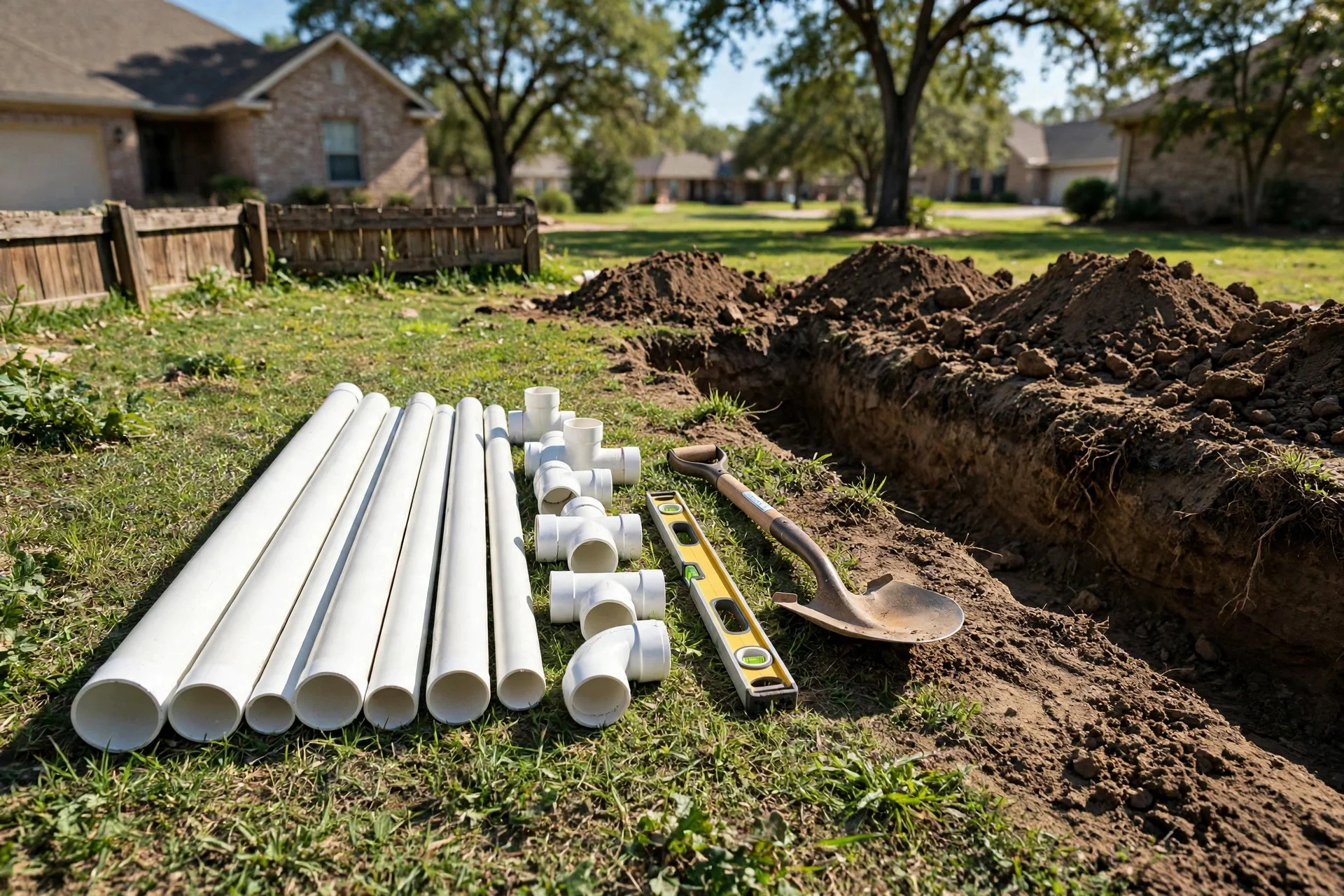
Replacement starts with the camera and a plan, not with a trench. We show you the footage across the whole run, we name the pattern that points to replacement, and we walk the yard run from the house to the street so you can see where the new line will go and what surface it will cross. That walk is part of the plan, because a replacement crosses lawn, walkways, driveways, landscaping, and utility runs, and the plan has to name each of those crossings before digging starts. We confirm the cleanout location, we confirm where the line runs, and we confirm what sits above it. A replacement that starts with a surprise crossing is a replacement that was not planned well enough, and surprises in a trench are expensive in a way surprises in a conversation are not.
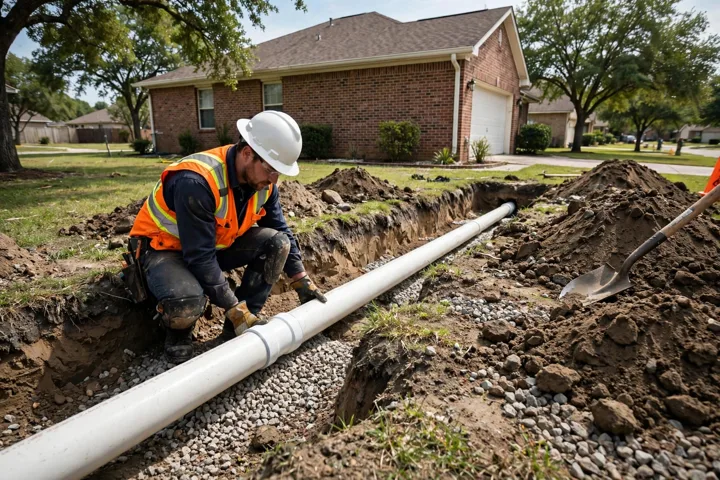
Excavation opens the run in sections, working from one end toward the other so the trench stays controlled and the yard stays workable. The crew removes the failed pipe as the trench opens, and the exposed pipe confirms the camera finding with eyes on the pipe itself. That confirmation matters, because camera footage can show a pattern, but eyes on the pipe show whether the pattern runs exactly where the footage suggested, whether the bedding under the failed run has washed out further than expected, and whether any section of the old line is worth leaving in place as part of the new run. If the exposed pipe shows more failure than the footage did, we stop and tell you before we proceed, because the plan changes if the failure extends further than expected. That conversation happens with the trench open and the facts visible.
Bedding, grade, and sealing the new line
Bedding goes in before new pipe, and bedding is the step that decides whether the new line lasts in clay ground. The crew sets bedding material under and around the pipe, spreading the load so no single point of the pipe carries the ground above it alone. New pipe is laid on that bedding and graded so water flows toward the street without pooling at any point along the run. Grade is set deliberately, not eyeballed, because a new line that holds water at any point has simply built a new belly into a new pipe. Joints are sealed as the pipe goes in, because a joint that is not sealed is a joint that Rockwall roots will find, and a new line with open joints is a new line with a short life. The crew works along the run in that order, bedding, pipe, grade, seal, section by section, until the new line reaches the street main.
Inspection comes before the trench closes, and it is not a formality. The crew runs water through the house fixtures and watches how the new line drains across the whole house, and runs the camera through the new line to confirm the bore is clean, the joints are sealed, and the grade holds no standing water. The camera pass after replacement is the proof that the work did what it was supposed to do, and we show you that footage too. The crew also confirms on site where the new line meets the street main, and the camera shows where the private run ends and the street main begins, which the crew confirms on site rather than asserting from any rulebook. Only after the water test and the camera pass does restoration start, which means backfilling in layers so the ground does not settle into a trench line, compacting as we go, and restoring the surfaces that were opened, whether lawn, soil, walkway, or driveway. A replacement is not finished when the pipe is in. It is finished when the line drains, the camera proves it, and the yard is back to the state it was in before digging.
- Camera footage across the whole run reviewed and the pattern named on screen.
- Yard run walked, crossings named, cleanout confirmed, plan agreed before digging.
- Excavation in controlled sections, failed pipe removed as the trench opens.
- Exposed pipe confirms the camera finding by eye, plan adjusted if failure extends further.
- Bedding set under and around the new pipe.
- New pipe laid and graded so water flows without pooling.
- Joints sealed as the pipe goes in, section by section to the street main.
- Water test through the house fixtures and camera pass through the new line.
- Backfill in layers, compaction, and surface restoration.
Bedding and grading in clay ground: why installs fail
Bedding and grading are the two words that decide whether a sewer line replacement in Rockwall, TX lasts, and they are also the two words most often skipped in a conversation about replacement. Bedding is the material that sits under and around the pipe. Its job is to spread the load of the ground above the pipe so no single point carries that load alone, and to hold the pipe at grade while the clay around it swells and shrinks. A pipe laid directly on bare clay sits on a surface that moves. When the clay swells, it pushes the pipe up at one point. When it shrinks, it drops the pipe at another. That movement, repeated across seasons, is exactly how a new line develops the same bellies and offsets that killed the old line. Bedding breaks that cycle by giving the pipe a stable cradle that does not swell and shrink with the clay, so the pipe holds its line while the ground around it moves.
Grading is the slope of the pipe, and its job is to keep water moving without pooling and without rushing. A line graded too flat holds water, and held water lets paper and grease settle, which narrows the bore and feeds the next blockage. A line graded too steeply lets water outrun the solids it carries, which leaves solids behind to build into a blockage further down the run. The correct grade is a narrow band, and it has to hold along the whole run, not just at the start. A new line that starts at the right grade and sags into a belly halfway to the street has failed at grading, even though the first section looked right. That is why grade is set section by section as the pipe goes in, and why the camera pass after replacement checks for standing water along the whole run rather than trusting the first section.
Why installs fail in clay ground
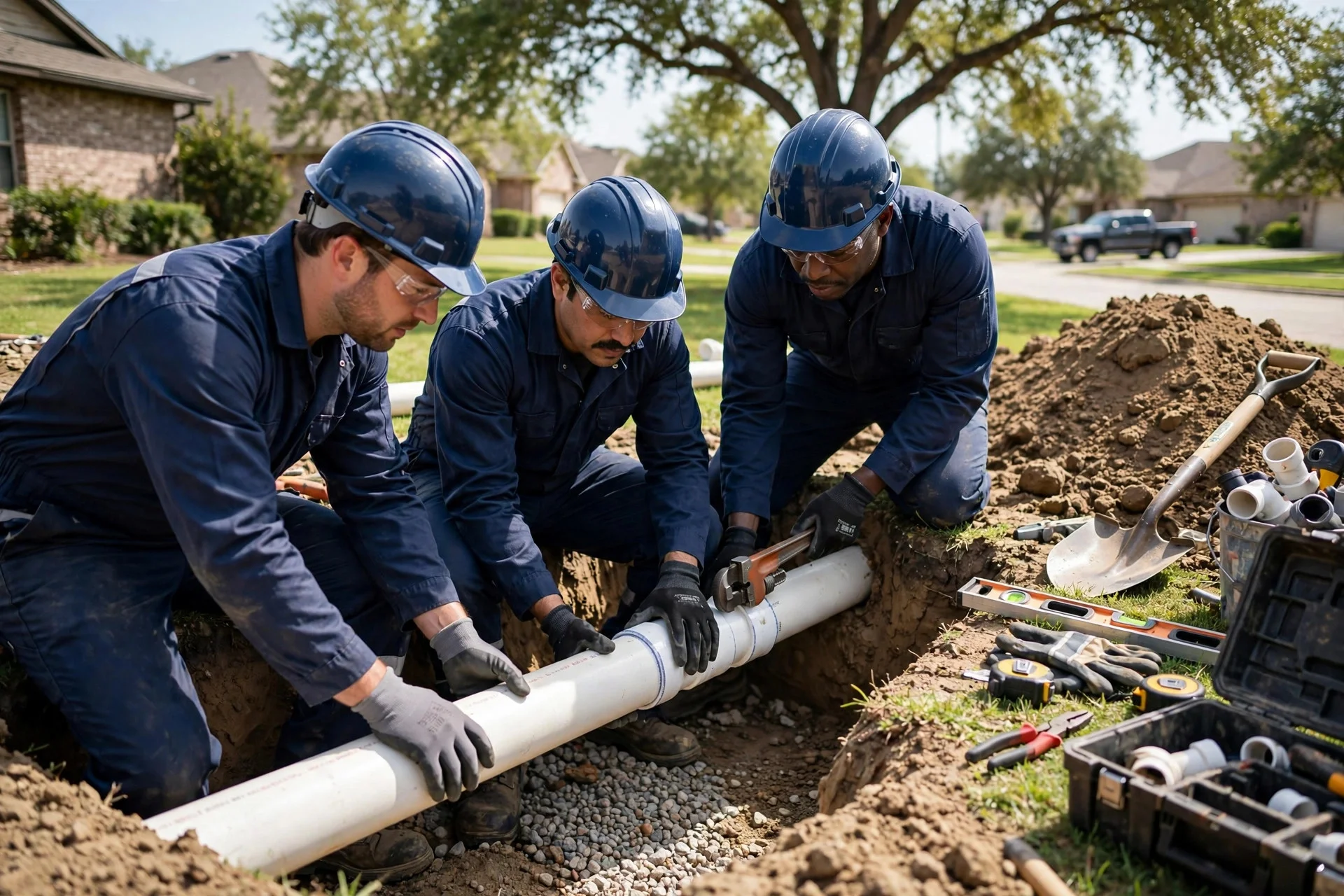
Installs fail in clay ground for a small set of reasons, and naming them helps a homeowner judge a replacement quote. An install fails when pipe goes in on bare clay with no bedding, because the clay will move it. An install fails when grade is eyeballed instead of set, because eyeballed grade drifts into flat spots that hold water. An install fails when backfill is dumped in a single lift instead of layered and compacted, because uncompacted backfill settles into a trench line and drags the pipe down with it. An install fails when joints are left unsealed, because roots find unsealed joints in the first growing season. Each of those failures is preventable, and each is visible in how the crew works: bedding material on site before pipe goes in, grade checked as the pipe goes in, backfill in layers, joints sealed as they are made. Ask to see those steps. A crew that can show them is a crew that has built for clay ground. A crew that cannot is a crew that has built a line the clay will move again.
The same bedding and grade rules decide whether a sewer line repair holds in clay, so the repair page walks through them for a single section too.
Replacement versus trenchless: summary plus link
Replacement and trenchless renewal answer different questions about the same failed line, and confusing them is how a homeowner ends up with the wrong job. Replacement removes the old run and installs a new pipe in an open trench. Trenchless renewal keeps the old line in the ground and renews it through small access points, either by lining the inside of the existing pipe or by bursting the old pipe and pulling a new pipe through its path. The difference is not which one sounds newer. It is whether the old line still holds its shape well enough to be renewed, or whether it has lost its shape and needs to come out.
The camera decides that question. A line that holds its shape, with a round bore and a path the lining or bursting equipment can follow, can qualify for trenchless renewal. A line that has collapsed, flattened, or deformed along a stretch cannot be lined into a round pipe, and bursting a collapsed line follows a path that is no longer reliable. That qualifying rule is the whole decision, and it deserves its own full explanation on the trenchless sewer repair page, which covers how trenchless works, what qualifies a line for it, and where its limits sit. We link there instead of repeating that explanation here, because a replacement page that also tries to be a trenchless page would blur the choice it is trying to clarify. If your camera footage shows a line that holds its shape, read the trenchless page before you agree to an open trench. If it shows a line that has lost its shape, replacement is the path, and this page is the one to follow.
For what moves a replacement number, the cost guide walks through the factors, so the footage and the price make sense together.
Older homes and full-run failure
Older homes are where full-run failure shows up most often, and the reason is the combination of pipe material and time in clay ground. Older Rockwall homes often still run cast iron, and cast iron fails along its length in a way that PVC rarely does. Scale narrows the bore year by year, and that narrowing happens along the whole run, not at one joint. Cracks open at joints that clay has shifted repeatedly, and each cracked joint lets in roots and water that soften the bedding and widen the next joint. By the time an older home reaches the replacement conversation, the camera often shows a line that is narrowed, cracked, and offset at multiple points, with bellies where the bedding has washed out. That is not a line with a failure in it. It is a line that has finished, and the honest work is a new line.
Lake neighborhoods show that pattern in local form, and naming them with specifics helps an older homeowner recognize their own house in the description. Chandlers Landing carries lakefront homes where mature trees and older sections meet newer builds, and a Chandlers Landing replacement often involves a long lateral under mature landscaping, where roots have entered at joint after joint along the run. The Shores runs the same mix, with long laterals from the house to the street that give roots more joints to enter and bellies more room to form, so a Shores replacement plan has to cover the full lateral on camera before the trench opens, not just the first failed section. The Harbor District sits close to the water, where the ground stays wetter longer and clay movement runs on a different cycle than the drier inland streets, which means Harbor District lines often show bedding failure along the run rather than at a single point, and the replacement has to address bedding along the whole run, not just at the worst joint. Those three neighborhoods do not need different trades. They need the same full run approach, applied to different combinations of age, trees, and ground.

Judge the line as a system
The practical point for an older homeowner considering sewer line replacement in Rockwall, TX is to judge the line as a system, not as a collection of individual joints. A line that has been repaired at one joint, then at another, then at a third, is telling you its schedule, and that schedule is the pattern replacement answers. A line that shows one local failure, even in an older home, is still a repair candidate, and the repair page covers that case. The camera footage across the whole run is what separates those two situations, and we show you that footage before we recommend either path.
Rowlett and Wylie full run failures get their own treatment on the drain cleaning in Rowlett and drain cleaning in Wylie pages, with the same whole run camera rule.
Living through a replacement: yard, access, phases of work
A replacement opens your yard, and a plain account of what that means is more useful than reassurance. The work moves in phases, and each phase changes what part of the yard is accessible. The first phase is marking and access, when the crew walks the run, marks the line, and opens the first sections of trench. During that phase the yard run is a work area, not a lawn, and the crew will tell you which paths across the yard stay open and which are closed while digging is underway. The second phase is excavation and pipe work, when the trench is open along the run and the new pipe goes in section by section. During that phase the trench itself is the work area, and it stays open until the pipe, bedding, grade, and joints for that section are confirmed. The third phase is testing and restoration, when the water test and camera pass confirm the new line, and backfill and surface restoration return the yard in layers.
Access during the work follows the trench, not the house. The crew needs access along the run, from the house to the street, and that access includes room for the trench, for bedding material, and for the pipe itself. Vehicles, stored items, and landscaping that sit directly above the run will need to move for the phase when that section is open, and the crew should name those moves before digging starts, not discover them halfway through. Water use in the house during the pipe work phase is limited by the state of the line, because the old line is being removed and the new line is not yet connected and tested, and the crew will tell you plainly when water can run again and when it needs to stay off. That conversation happens at the start of each phase, so no one is surprised by a closed drain in the middle of a work phase.
What a replacement does not require is a promise about timing that no crew can honestly make before the trench is open. The ground, the crossings, and the condition of the old pipe as it comes out all shape how the phases progress, and a crew that promises a finish before seeing the trench is guessing. What a crew can promise is the order of work, the checks at each phase, and the communication at each transition: marking before digging, camera confirmation before closing, water test and camera pass before restoration, and a walk of the restored yard with you at the end. Those are the parts of a replacement you can hold a crew to, and they are the parts that decide whether the new line lasts.
The replacement questions we hear most are answered on the FAQs page.
How do I know if my line needs replacement instead of repair?
The camera footage across the whole run decides. One local failure with sound pipe around it is a repair. Failed joints repeating along the run, a pipe that has lost its shape, bellies in sequence, or a bore narrowed along a long stretch are replacement signals. Ask to see the footage across the full run before you agree to either.
What happens to my yard during a replacement?
The yard run from the house to the street becomes a work area in phases: marking and access, excavation and pipe work with the trench open along the run, then testing and restoration. Backfill goes in layers with compaction, and surfaces that were opened are restored. The crew should name every crossing and every move of items above the run before digging starts.
Why does bedding matter so much in Rockwall clay?
Because clay swells and shrinks with wet and dry seasons, and a pipe laid directly on bare clay moves with it. Bedding gives the pipe a stable cradle that does not swell and shrink, so the pipe holds its grade while the ground around it moves. A new line without proper bedding develops the same bellies and offsets that killed the old line.
Could trenchless renewal work instead of an open trench replacement?
It can, if the old line still holds its shape well enough to be renewed. A line that has collapsed or deformed along a stretch cannot be lined back into a round pipe. The trenchless page explains the qualifying rules in full, and the camera footage shows whether your line qualifies. Read that page before agreeing to an open trench if your line still holds its shape.
What should I expect after the new line is in?
A water test through the house fixtures and a camera pass through the new line, both shown to you, confirming a clean bore, sealed joints, and grade with no standing water. Then backfill in layers, compaction, and surface restoration, followed by a walk of the restored yard with the crew. The replacement is finished when the line drains, the camera proves it, and the yard is restored.
Related Services
One trade, seven services. Every service below is drain and sewer only.
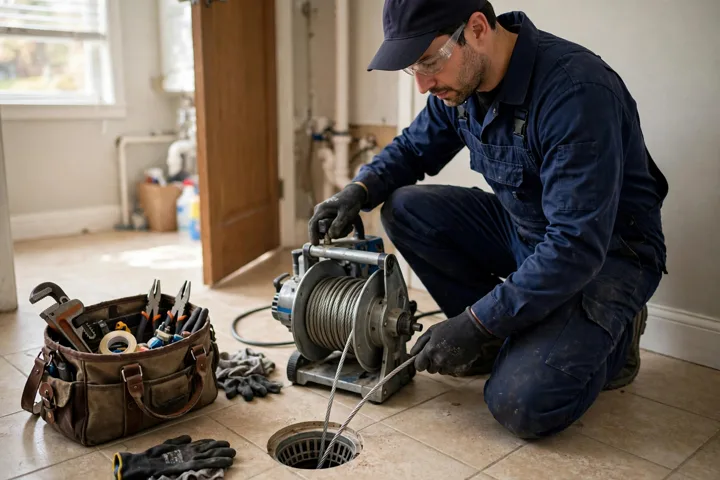
Drain Cleaning
Snaking and clearing for sinks, tubs, toilets, and main lines, with the cause found, not guessed.
Learn more
Emergency Drain Service
Backups and sewage overflows answered fast, with a crew that shows up ready.
Learn more
Sewer Line Repair
Spot repairs and section fixes, located by camera first, so we open only what must be opened.
Learn more
Trenchless Sewer Repair
Pipe lining and bursting that renew the line through small access points, not a torn up yard.
Learn more
Hydro Jetting
High pressure water scouring that strips grease, scale, and roots back to a clean pipe wall.
Learn more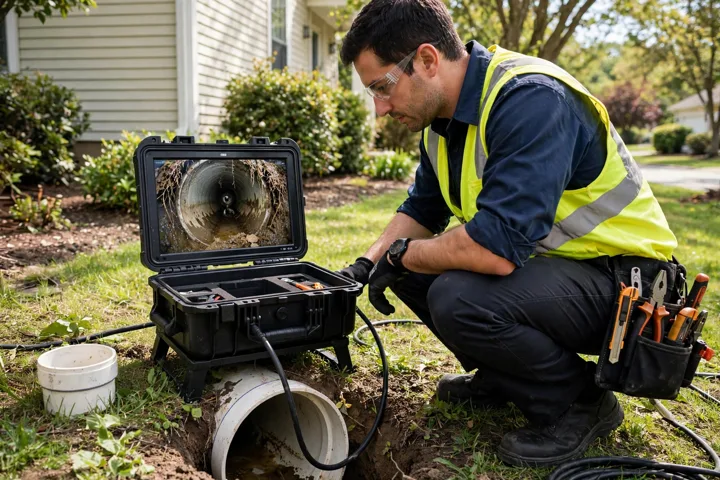
Sewer Camera Inspection
A recorded look inside the line: roots, cracks, bellies, and offsets, shown to you on screen.
Learn moreKeep Reading
Related pages worth opening next, with the ground detail that belongs to each one.
Rowlett
Drain and sewer service for Rowlett homes, from a crew that serves the Rockwall lake footprint.
Learn moreWylie
Drain and sewer service for Wylie homes, from a crew that serves the Rockwall lake footprint.
Learn moreDrain and Sewer Cost Guide
What drives the price of drain cleaning, repair, replacement, trenchless, jetting, and camera work, no guesswork.
Learn moreDrain and Sewer FAQs
Straight answers to the questions Rockwall homeowners actually ask us, in plain language.
Learn moreIndustry reference: NASSCO publishes technical resources on the assessment, maintenance, and rehabilitation of buried sewer assets. NASSCO.